Stacked Chairs, Unscripted Joy: Why the Last Twenty Minutes Belong in Your Wedding Film
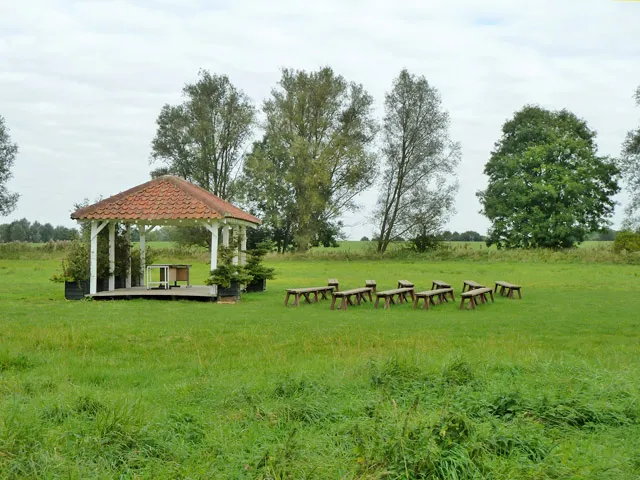
Photo: Robin Webster , CC BY-SA 2.0, via Wikimedia Commons
It’s gone half eleven. The band are coiling cables into the back of a van, someone from the venue is stacking chairs with the quiet efficiency of a person who has done it a thousand times, and the dance floor is a constellation of discarded heels and half-finished drinks. Your timeline ended twenty minutes ago. And yet, this is often the part of the day that feels most like yours.
The bit nobody puts on the run sheet
Most wedding timelines are built around the big beats: ceremony, drinks, speeches, first dance, last song. The final twenty minutes after the last song rarely get a mention. Couples are tired, guests are hunting for taxis, and the venue has one eye on the clock. It can feel like the wedding is over.
But on film, that window often does something the rest of the day can’t. The performance drops. The room empties. The couple stops being the centre of a production and starts being two people in a nearly empty space, surrounded by the evidence of a very good day. It’s not glamorous. It’s better than glamorous — it’s真实, unforced, and quietly funny.
Why it reads differently on camera
Earlier in the day, almost everyone is slightly aware of being watched. Guests straighten jackets when a lens drifts past. Couples hold a pose for half a second longer than they need to. That’s not a criticism; it’s just human. But by the final twenty minutes, most people have stopped bothering. The camera becomes furniture. That’s when you get the good stuff: a private joke muttered over a stack of chairs, a bridesmaid doing a final lap of the room looking for a lost earring, the groom carrying three gift bags and a centrepiece like a man navigating a small obstacle course.
This is also where the sound changes. The DJ has packed down, the band has gone, and the room has that particular echo of a space that was recently full. Chairs scrape. Someone laughs too loudly in the corridor. A taxi honks outside. If your filmmaker is set up to capture ambient audio, those small sounds can do more for the emotional truth of a film than another sweeping track.
The curfew conversation you need to have early
UK venues are not being difficult when they mention curfews. Council licensing, noise limits, village hall committees, marquee neighbours, and staff finishing times are all real considerations. A barn in Somerset and a hotel in Leeds will have different rules, and both will have something to say about when the music stops and when suppliers leave.
So ask early. When you’re booking your filmmaker, check whether they can stay for twenty to thirty minutes after the last song. Some venues will allow it; some will need suppliers out by midnight sharp. If the answer is no, don’t try to bend it. Instead, ask your filmmaker to capture the final ten minutes before the official end — the last dance, the goodbyes, the couple doing a quiet lap of the room while the DJ plays the penultimate song. You can still get the feeling without breaking the venue’s terms.
If the venue is flexible, put it in writing. A short email that says “filmmaker will remain on site until 12:15am for pack-down footage, no additional equipment” is usually all it takes. It also gives the venue staff a heads-up so they’re not surprised by a camera in the corner while they’re trying to get home.
How to plan it without staging it
The worst thing you can do is turn the final twenty minutes into a photo call. No one wants a director’s note at that hour. The goal is simply to give your filmmaker permission to stay and observe, and to give yourselves permission to be a bit useless.
A few practical things help. Keep a pair of flats or trainers accessible. Have water and a snack within reach — the last hour of a wedding is not the time to discover you’re running on canapés and adrenaline. Let your closest friends know they’re welcome to linger rather than being herded out. And tell your filmmaker, plainly: “Stay for the pack-down. Film us doing nothing. Don’t ask us to pose.”
That last instruction is the important one. The final twenty minutes work because they aren’t a performance. A couple sitting on a step outside the marquee, shoes off, sharing the last slice of cake, is not a shot you can art-direct without ruining it. It’s a shot you can only allow.
What you’ll actually rewatch
You probably won’t rewatch a perfectly lit wide shot of the room at 9pm. You might well rewatch your dad trying to fold a tablecloth, or your friend doing an interpretive dance with a stack of chairs, or the two of you walking back through the empty ceremony space with a bin bag and a look of exhausted delight.
Those moments aren’t in the brochure. They’re in the margins. And in a wedding film built to last, the margins are often where the story lives. The last twenty minutes aren’t an afterthought — they’re the exhale. Give them a bit of room, and they’ll give your film something no timeline can schedule.