Throw, Don't Scramble: Choreographing a Confetti Exit Worth Filming
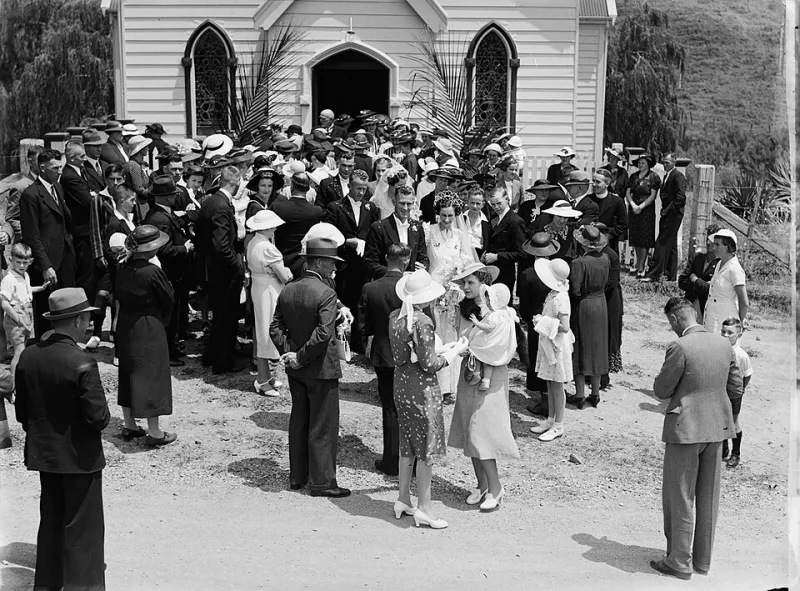
Photo: Collins, Tudor Washington, 1898-1970, photographer, CC BY 4.0, via Wikimedia Commons
There is a moment on every wedding day when the entire guest list is looking at the same thing and doing the same thing at the same time. It lasts about five seconds. On film, that moment either lands like the last scene of a proper film or it looks like a scrum outside a garden centre. The gap between those two outcomes has almost nothing to do with budget and quite a lot to do with ten minutes of planning.
Five Seconds, One Take (Sort Of)
A confetti exit is short, loud and slightly chaotic by nature. You cannot fully control it, and you shouldn't try, because the good stuff lives in the mess. What you can control is where people stand, which way they throw and how fast you walk. That's it. That's the whole job. Get those three things roughly right and the rest takes care of itself.
Read the Rules Before You Buy a Single Petal
Start with the venue, not the shopping. Plenty of churches only allow confetti outside the porch, and many ask for biodegradable paper or dried petals only. Register offices on council property often ban it altogether, and National Trust and stately home venues usually have a preferred spot and a preferred product. One email to the coordinator saves an awkward conversation on the day, and it also tells you where to stand, which your filmmaker will thank you for.
Buy more than you think you need. Roughly half again as much as feels sensible. Cones are the classic, but a shallow basket passed along the line works better on camera because hands stay low and faces stay visible. If you're using petals, dry them flat on newspaper for a week beforehand; frozen ones go limp and grey the moment they hit the air.
Wind Is the Uncredited Second Director
Check the forecast the night before and again at breakfast. If it's breezy, position your two lines so the wind blows across the frame rather than into everyone's faces. Paper confetti is heavier and behaves better in a gust; petals are prettier in still air but travel like snow in anything above a light breeze. Ask guests to throw upward and forward rather than directly at your heads. A low, generous throw reads beautifully on camera. A fistful to the face reads like an accident, because it is one.
Two Loose Lines, Not a Group Hug
Left to their own devices, guests will crowd into a tight clump about three feet from the door. Give them a shape instead. Two loose lines, roughly arm's length apart, with enough space down the middle for a dress and a train. Ask a confident friend, the one who organises everything anyway, to stand at the back with a basket and keep the line moving. Seat the older guests at the front of the lines rather than in the middle, and give any small children a specific job, because a child with a job is a child not standing directly in front of the lens.
Walk Slower Than Feels Polite
This is the bit couples always rush. The instinct is to power through, head down, eager to get to the other end. Resist it. Walk at about two-thirds of your normal speed, look up, and hold hands. Don't stop to straighten your dress and don't look at the floor. Pause halfway for a kiss, which gives your filmmaker a beat to catch a wide shot and a close one without panicking. Then keep going, and when you reach the end, turn around. That turn gives you a second burst of confetti, a lovely frame of your guests' faces, and a natural end to the scene.
There Is Always One Guest Who Throws Early
Every wedding has them. Usually a beloved uncle. Give that person a job instead, ideally one involving holding the spare basket, and brief everyone at the same time: nobody throws until you're actually in the doorway. A single sentence from the celebrant or a best mate does more than a printed sign ever will.
Plan B That Doesn't Feel Like a Compromise
British weather has opinions. If it's coming down sideways, move the whole thing into the porch, under a covered walkway or just inside the venue door with guests lined up along the corridor. Bubbles look superb backlit but hopeless in wind, ribbon wands are dependable and photograph well indoors, and dried lavender smells better than it sounds. Some couples stage a second, smaller exit later in the day at the reception, which is often the version that ends up in the film. Worth asking whether your venue charges a cleaning fee before you commit to a wheelbarrow of paper.
What Your Filmmaker Actually Needs
A minute of warning, a clear sightline and permission to stand ahead of you rather than behind. Ask someone to keep the back of the line moving so the frame doesn't fill with shoulders. Tell your filmmaker where the exit ends so they can be there before you are. If you have two cameras, one wide and one in the middle of the line is the ideal split.
And then the bit nobody remembers: look at each other, and laugh. That's the frame you'll actually rewatch at seventy.