In the Room, Out of Frame: Filming a Wedding When Someone Hates the Camera
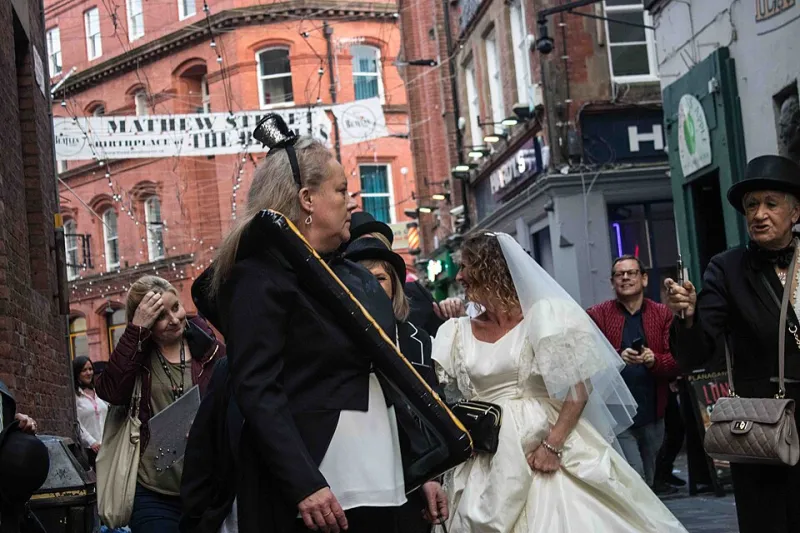
Photo: Sue Emery uploaded by: Cartridge Save A Day in the Life, CC BY 2.0, via Wikimedia Commons
There is a particular manoeuvre you see at almost every UK wedding. A lens swings towards the top table and one guest rotates away with the smooth, practised urgency of a person avoiding a wasp. Often it is a brother, an uncle, a mate of thirty years who has never once willingly stood in a group photo. They are not being awkward for sport. They simply do not want to meet the version of themselves that gets frozen mid-blink and kept forever.
So let us say the useful thing first: your wedding film does not need that person in it. Not in close-up, not in the background of the first dance, not at all if that is what they want. A film made to last fifty years needs to feel honest about the day, and a guest who has been gently cornered into a frame is not honesty — it is a hostage situation with nice lighting.
What follows is a practical, slightly softer guide to filming a wedding when someone you love hates the camera.
Ask once, properly, and then drop it
Consent at a wedding is not a single yes or no at the start of the day. It is a small, ongoing conversation, and it works best when it happens weeks before anyone is wearing a waistcoat.
Ask directly, in plain words, and offer options rather than a binary. Some people are happy to appear in wide shots but not close-ups. Some will happily be heard but not seen. Some would rather be entirely absent from the final cut and will still dance like nobody is watching — because, as far as they are concerned, nobody is. All three are reasonable answers, and all three can be worked with.
What you should not do is ambush them at the reception with a cheery please-just-ignore-the-camera. They cannot ignore it. That is rather the point.
Learn the tell
Camera-shyness has a body language all of its own, and it is usually quieter than people expect. The hand that comes up to adjust a hair that does not need adjusting. The sidestep behind a partner. The sudden, pressing need to check whether the bar has run out of the good gin. A guest who has drifted to the edge of every group is telling you something, and it is not a request for more coverage.
Worth knowing, too: plenty of people who hate being photographed are not shy at all. They are the loudest person in the room, and they simply do not want a still, silent record of their own face. Treat it as a preference rather than a fear and you will get much further.
Hands, shoulders, reflections
Here is where a good filmmaker earns their keep. There are dozens of ways to show that someone was there without pointing a lens at their nose.
Hands are quietly brilliant: clapping, holding a glass, resting on a shoulder during a speech, passing a tissue along a row. A back turned to the camera while watching the ceremony is oddly moving, because it puts the viewer in the room, looking the same way. Reflections in a sash window or a marquee mirror can give you a figure without a face. A silhouette in a doorway at dusk does more work than a full-frontal portrait ever could.
And there is the wide shot, which we will come back to because it is the most underrated tool in the kit.
Let the sound do the work
If a guest will not be filmed, ask whether they might be recorded. A voice is a strange and generous thing, and a few seconds of someone laughing off-camera, or a line from a speech, or a bit of chat at the table can carry an entire section of a film.
This is where wedding films quietly beat photographs. A photo of an absent uncle is a fact. An audio clip of him telling a terrible joke is a memory. Most people are far more relaxed about a microphone on the table than a lens in their eyeline, because it asks much less of them.
The wide shot is a kindness
A wide shot is not a cop-out. It is a way of including someone without exposing them. The long table from the back of the room, the dance floor shot from the doorway, the ceremony framed from behind the last row: these are the shots that make a film feel like a room rather than a highlight reel.
If a camera-shy guest is happy to be in the room but not in the frame, the wide shot is your compromise, and it is a good one. They are present. They are part of the day. They are simply three inches tall and slightly blurred, which is exactly how they would like to remain.
Tell your filmmaker before the day
This is the practical bit. Send a name, a description, and a request. Please do not put Uncle Ray in close-up is a completely normal thing to say, and every decent filmmaker would rather know in advance than discover it in the edit.
Agree a small signal if it helps — a hand raised, a step back, a hand on the camera strap. And then resist the urge to point them out on the day. Nothing makes someone feel more watched than being told they are not being watched.
A film is not an attendance register
The quiet fear behind all of this is that the film will feel incomplete. It will not. A wedding film is not an inventory of everyone who came; it is a record of how the day felt.
Someone can be entirely absent from the frame and still be all over the film: in the way their partner laughs at a joke only they would make, in the story told about them during a speech, in the drink bought and the seat saved. A film made to last forever is not a headcount. It is a feeling, edited.
And here is the last thing, which is really the first thing. The best measure of a wedding film is not how many faces it contains but whether the people in it recognise the day. If the guest who hates cameras watches it, enjoys it, and says — slightly surprised — that they barely noticed themselves, you have done it right. And if they are not in it at all, they will probably love it even more.