Nobody's Watching, Everybody's Crying: Filming the First Dance You Never Rehearsed
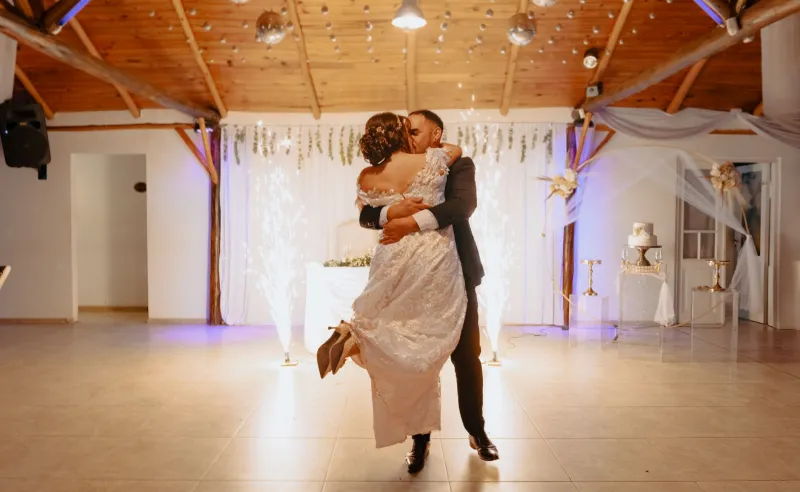
There's a particular look that crosses a couple's face when the DJ announces the first dance. It's part terror, part dread of being watched, and a small flicker of hope that the floor might open up and swallow them politely. If that sounds familiar, take a breath. You do not need six weeks of lessons, a lift, or a routine you'll forget by the second chorus. Some of the most rewatchable first dances we've filmed have been two people swaying slightly out of time while their mates whooped from the side.
The trick isn't dancing well. It's setting the room up so that whatever happens in the middle of that floor looks and sounds like you.
Why the polished version often ages badly
Choreographed dances can be lovely. They can also be a bit like watching someone else's exam result. Everything lands, the lift happens, the applause is generous — and then, ten years later, it's a performance to music rather than a memory of a feeling.
The dances that hold up are the ones with a wobble in them. A groom counting under his breath. A bride laughing so hard she has to stop. A dad cutting in forty seconds early because he couldn't help himself. Those are the frames you'll actually replay, because they're the ones with a pulse.
Start with the song, not the steps
Before you think about anything technical, choose a song you genuinely love. Not the one that sounds cinematic. Not the one your mum has always wanted you to use. The one that makes you both look at each other and go, "yeah, that one."
A few practical things worth knowing:
- Shorter is kinder. Most couples are done at around ninety seconds to two minutes. Ask your DJ or bandleader to fade the track out early rather than letting it run to four minutes of increasingly awkward swaying.
- A song with lyrics helps. Silence on a dance floor is the enemy. Words give you something to mouth at each other when your brain goes blank.
- Have a Plan B cued. If it all gets too much, the best weddings have a second track ready — something like September or Come On Eileen — so the DJ can pull the crowd in and rescue you with a wave of guests.
Alternatives that film beautifully
You're allowed to skip the solo spotlight entirely. Some options that have worked brilliantly:
The wall of sound. You start the dance, and the DJ invites everyone up after sixty seconds. The camera stays on you for the first half, then pulls back to catch the whole room filling the floor around you. You get the intimacy and the party, without the lonely middle.
The band swap. You dance to something slow, then the band crashes into a floor-filler and nobody has to keep swaying. The transition is a great bit of film, too.
The childhood song. Play the track that was on in the car on family holidays. People lean in. Grandparents tear up. You stop worrying about your feet because you're too busy being eight years old again.
The dance between families. Ask both sets of parents to join you for the second half. It becomes less about being watched and more about being held by the room — which is what the day is really about.
Setting up the room so it works on camera
This is the bit most couples never think about, and it's where you get the biggest gains.
Clear the floor properly. Not just enough space for a two-step. Ask the venue to push tables back so there's a genuine radius around you. It gives a filmmaker room to circle, and it stops a stray chair leg from ending up in every wide shot.
Think about where the light is. A dark dance floor with one harsh spotlight will make you look like you're being interrogated. Ask for warm side lighting — festoon bulbs, up-lighters on a dimmer, a bit of ambient glow from the room. If your DJ brings coloured wash lights, ask whether they can be softened for the first dance and turned up afterwards.
Stand side-on to windows if there are any. Late evening in a barn with the doors still open — that's as good as it gets in this country, so make sure you're positioned to make the most of it.
Tell your photographer and filmmaker where you'll be. A two-minute heads-up about which corner of the floor you're starting in saves a lot of scrambling, and it means the camera is already rolling when you step out, not fumbling into position as the song begins.
What a filmmaker is actually looking for
It's rarely the footwork. We're watching for the things that happen in the gaps:
- The way one of you leans in to say something that nobody else will hear.
- A hand moving up to the back of a neck — a small, protective gesture.
- Your mates in the background, already crying before the chorus.
- The moment you forget the camera is there and your shoulders drop about three inches.
- Two minutes later, the blur of the same floor absolutely rammed with people.
We'll typically shoot the first dance from three angles: a wide from the back of the room to show the scale of it, a mid-shot from the side to keep your faces visible, and a slow close move that picks up the small stuff. The edit uses all three, but it leans on the close moments because that's what people cry at.
One last bit of advice
Don't rehearse yourself out of being nervous. A little bit of terror is charming. It reads on camera as honesty — the quick glance at your mate, the whispered "what do we do now", the ridiculous little shuffle step you've been doing in your kitchen since you were seventeen.
That's the version of you your grandkids will want to see. Not the one who nailed the routine.
Get the room right, pick a song that means something, and then let the wobble happen. Two left feet, one take, and a moment that stays warm for a very long time.