Where the Laughs Live: Designing a Wedding Room That Films Beautifully
There’s a moment in every wedding film when the room does the work for you. It’s not the vows, and it’s not the first dance. It’s the split second after a speech lands — the ripple of laughter that moves across the tables, the aunt who throws her head back, the old friend who catches the bride’s eye and pulls a face they’ve been pulling since Year 9. You can’t script that. But you can seat it.
Most couples think of the table plan as a diplomatic exercise: separating the uncle with opinions from the cousin with a podcast, keeping the university lot away from the rugby lot, making sure Grandma has a clear route to the loo. All of that matters. But the seating chart is also a map of where the camera will find its best moments. Get it right, and your film feels alive — full of real people reacting in real time. Get it wrong, and you end up with a beautiful film of the back of everyone’s heads.
The top table isn’t a fortress
A traditional top table — couple in the middle, parents and bridal party fanned out either side — looks lovely on paper and can feel like a bunker on film. Everyone faces forward, the camera sees a row of polite smiles, and the people most likely to make you laugh are often seated behind you, out of shot.
If you’re wedded to the tradition, fine. But think about the angle. A long top table works best when it’s positioned so the camera can get along the line, catching glances and whispered asides. If your venue has a head table pushed against a wall, ask if it can come forward. A metre of space makes the difference between a static row and a living one.
More and more UK couples are choosing a sweetheart table — just the two of you — and scattering the wedding party among the guests. On film, this is gold. You get to see your best friends’ faces during the speeches, not their shoulders. You get reactions from the people who know you best, and the camera gets a room that feels connected rather than divided into a VIP section and everyone else.
Put the laughers in the camera’s eyeline
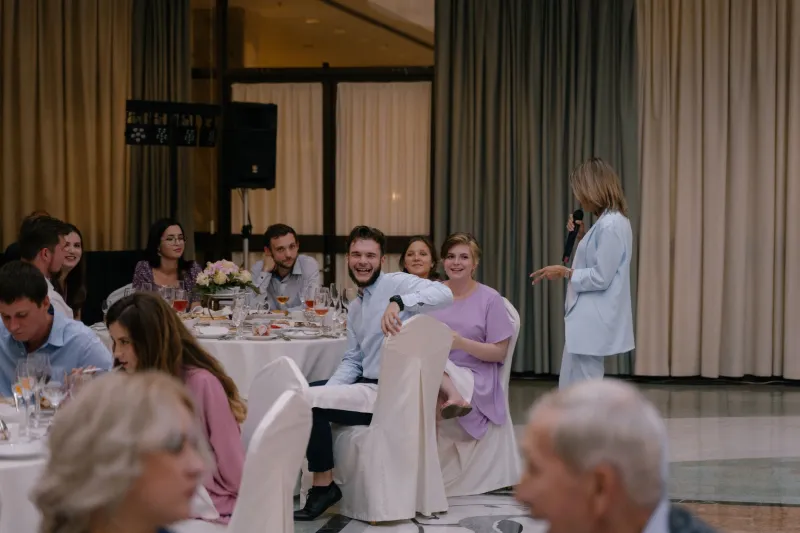
Think about who makes you laugh. Not the politest people, necessarily — the ones who set you off. The friend who does the impression of your dad. The cousin who tells the story about the caravan holiday in Tenby. The work mate who has a laugh you can hear in the car park.
Seat those people where the camera can see them during the speeches. That usually means tables to the side of the top table, angled towards the action, rather than directly in front of it. If they’re dead centre, the camera has to shoot over their shoulders to get the speaker. If they’re slightly off-axis, you get a clean line on their faces while they react.
This isn’t about staging a performance. It’s about giving the room a chance to show its personality. The best wedding films are full of faces you recognise — the people who made the day feel like yours.
Sound travels: where to seat the loud and the quiet
Speeches are the audio centrepiece of most wedding films. You want to hear the clink of glasses, the nervous laugh before the first line, the pause before the punchline. But you also want to hear the room’s reaction without it swallowing the speaker.
If you’ve got a table of people who laugh loudly and often — and you probably do — don’t put them right next to the speaker’s microphone. Put them a few tables back, so their laughter reads as a warm wave rather than a wall of sound. Conversely, the quieter guests, the ones who lean in and listen, are lovely to have close to the action. Their stillness gives the editor space to breathe.
A word on marquees and village halls: sound bounces. If you’re in a space with hard floors and little soft furnishing, the clatter of cutlery can overwhelm everything. Seating the chattiest table near a curtain or a soft wall helps absorb some of that. It’s not a technical fix, just a small bit of acoustic common sense.
The expressive aunt and the uncle who cries
Every family has them. The aunt who gasps at every reveal. The uncle who wells up during the father-of-the-bride speech and pretends he’s got something in his eye. The grandmother who claps a beat too late and doesn’t care.
These people are the heart of a wedding film. Seat them where the camera can find them — not front and centre, but in the mid-ground, slightly to the side, with a clear view of the top table. If they’re hidden behind a pillar or a floral arrangement, you lose them. If they’re right in front of the speaker, the camera might only catch the back of their head.
The sweet spot is a table that’s close enough to feel the emotion, but angled so the camera can see their faces. Think of it as casting the room. You’re not directing anyone, just making sure the people who feel things visibly have a seat in the light.
Children: chaos or gold?
Children at weddings are unpredictable. On film, that’s usually a gift. A toddler escaping across the dance floor, a flower girl lifting her dress over her head, a small boy asleep under a table — these are the moments couples rewatch at seventy.
But you don’t want the kids to dominate every frame. Seat them near the back or to the side during the speeches, ideally with a clear run to a parent if things go sideways. If there’s a kids’ table, put it where the camera can catch the odd moment of mischief without it becoming the main event. And if you’ve got a child who loves the spotlight, seat them close to the dance floor. They’ll find their moment.
The room as a whole: sightlines and light
Before you finalise the plan, stand in the room. Look at where the speeches will happen. Look at where the windows are. Look at the light. If the sun sets behind the top table, your camera will struggle. If the only route to the cake is through a maze of chairs, the footage will be a lot of shuffling. These are small things, but they add up.
Ask your venue if you can move tables slightly. Most are happy to oblige. You’re not asking for a film set — just a room that lets people see and be seen.
A note on not over-producing
The temptation, once you start thinking about the camera, is to turn the seating plan into a storyboard. Don’t. The goal isn’t to engineer reactions; it’s to remove the obstacles that stop them happening naturally. Seat people who love each other near each other. Put the laughers where they can laugh. Give the criers a clear view. Then forget about it and enjoy your dinner.
The best wedding films aren’t the ones where every table was placed with military precision. They’re the ones where the room felt like a room full of your people — and the camera just happened to be there to catch it.