Say It in Both: Filming a Bilingual Wedding Without Turning It Into a Translation Exercise
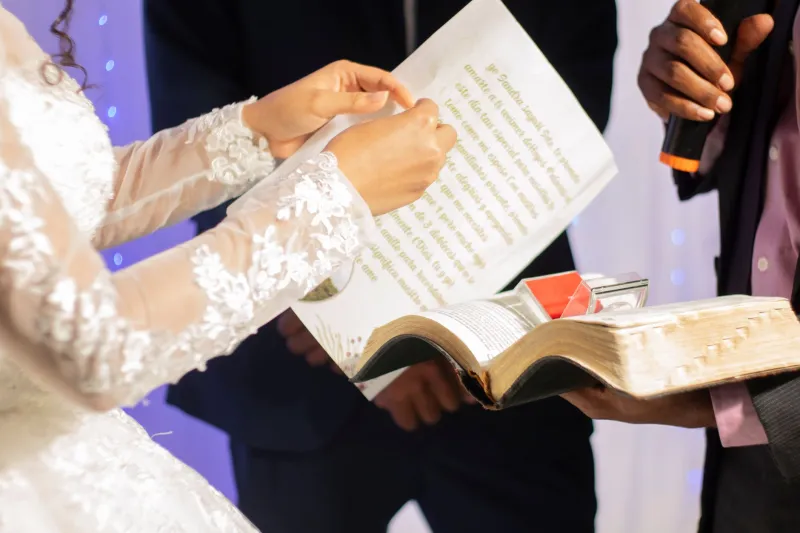
UK weddings have always been multilingual, even when the paperwork isn’t. A Cardiff register office with Welsh and English weaving through the room. Polish vows in a Manchester church hall. Urdu blessings, Yoruba hymns, Gujarati readings, a grandmother’s line that lands in Punjabi and makes everyone laugh before anyone has translated it. The languages change, but the pressure is often the same: make sure both sides of the family feel included without turning the wedding film into a language lesson.
That’s the tricky bit. A bilingual ceremony can easily become a checklist on camera — here’s the translation, here’s the cultural moment, here’s the bit where we prove we honoured both sides. But a wedding film isn’t an exam. It’s a story about two people and the people who raised them. The languages are part of that story, not a problem to be solved.
Start with the sound, not the subtitles
The most common mistake in bilingual wedding films is treating the edit as the place where meaning gets fixed. It isn’t. If the audio is muddy, no elegant subtitle will save it. If the room swallows the vows, the film will always feel like it’s reaching for something it can’t quite hold.
So the practical work starts before anyone presses record. A camera-mounted mic will happily capture the hum of a church fridge, the click of heels and the celebrant’s every breath. It will not reliably capture a quiet vow in a second language. Couples should talk to their filmmaker about lavaliers on both partners, a separate recorder near the readings, and — where the venue allows it — a feed from the sound desk. If there are multiple speakers in different languages, someone needs to know who is speaking, when, and where they’ll be standing.
This is where a simple language map helps. Not a rigid schedule, just a clear note of which parts happen in which language, who is leading them, and which lines are personal rather than formal. If the legal vows have to be in English, perhaps the emotional vows are in another language, or a reading is. If there are two versions of a vow, decide which one is the anchor for the film. The other can be an echo, a response, a moment of translation that belongs in the story rather than the subtitles.
Subtitles should be a window, not a wall
Subtitles can be beautiful. They can also make an audience read a film instead of watching it. The trick is restraint.
Not every line needs translating. A wedding film is not a court transcript. Subtitles work best when they open a door to the moment that matters: the promise itself, the punchline of a speech, a blessing from a parent, the one sentence a grandparent has travelled to say. If a guest tells a long, winding story in Gujarati and the room is laughing, the laughter is already doing some of the work. Subtitle the line that lands, not the whole anecdote.
Style matters too. Burned-in subtitles can look cinematic if they’re simple, well-timed and placed with care. Clunky fonts, all-caps and subtitles that cover faces will pull people out of the moment. It’s worth asking whether the couple want a version with subtitles and a version without, especially if the film will be watched by family members who speak both languages and those who don’t. A good filmmaker will treat this as part of the edit, not an afterthought added in a panic.
And please — let the music breathe. If every silence is filled with a soaring track, the second language never gets a chance to sit in the room. Sometimes the most powerful subtitle is none at all: just a face, a pause, and the sound of someone’s voice doing something familiar.
Honour the ritual without making it a checklist
Cultural moments are not B-roll. They’re not there to prove the film is diverse or well-researched. They’re there because they mean something to the people in the room.
The best way to film them is to ask better questions beforehand. Not simply ‘what rituals are happening?’ but ‘what would be missed if we only filmed the obvious bits?’ Maybe it’s the order of blessings. Maybe it’s the aunt who sings. Maybe it’s the specific tea set, the fabric, the way a father greets a new son-in-law. A filmmaker who understands the rhythm of the day will know when to stay back and when to move closer. A filmmaker who treats it as a tick-list will film the props and miss the people.
There’s a fine line between honouring a tradition and turning it into a performance for the camera. The difference is usually whether the family feels watched or welcomed. Couples should feel free to say what matters and what doesn’t, and to flag anything that shouldn’t be filmed at all. A bilingual wedding film should feel like both families were in the room, not like one family was given a translation.
The conversation before the day
Before the wedding, couples and their filmmaker should talk about language in the same breath as timings and shot lists. Which language is legal, which is emotional, and which is simply the one that feels like home? Who needs to understand the vows? Are there names or pronunciations the filmmaker should practise? Are there family sensitivities around translation, or jokes that only work in one language? Would the couple rather have a lightly subtitled film or a fully translated one?
It also helps to have someone trusted who can check subtitles for tone, not just accuracy. A literal translation can flatten a joke or sharpen a sentiment that was never meant to cut. And if readings or speeches are being recorded, the speakers should know that — not so they perform, but so they don’t feel ambushed by a microphone.
Editing for two audiences
A bilingual wedding film doesn’t have to explain itself every thirty seconds. One cut can hold two languages without turning into a lecture. Sequence a line in one language, then a reaction from the other side of the room. Let a translation arrive late and land softly. Leave space for the untranslatable bits — the laughter, the sighs, the uncle who says something short and devastating in his first language and then shrugs.
That’s the real work. Not proving that every word was captured, but making sure every person in the film feels present. A bilingual wedding film should be a family album with sound: both languages, both sides, one story that lasts.