Small Room, Big Screen: The Quiet Cinema of a UK Register Office Wedding
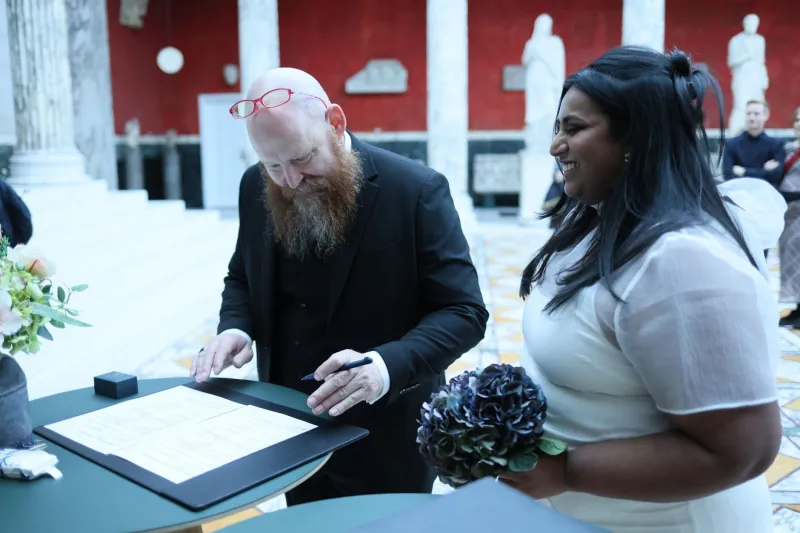
The register office is not usually the bit couples dream about. It is the appointment, the notice period, the two witnesses, the brown envelope of certificates. But spend a morning in a UK town hall with a camera and you start to see something else: a small room with a lot of feeling in it. A couple laughing too loudly in the corridor. A grandmother in a good coat. A registrar who has done this a thousand times and still knows how to make the room go quiet.
At One Forever Films, we have filmed civil ceremonies in grand civic buildings, modest council chambers and side rooms with a rubber plant in the corner. None of them felt like a lesser wedding. They felt like weddings with the volume turned down—and that can be extraordinarily cinematic.
The Drama Is in the Details
A register office ceremony has a natural shape. There is the wait outside, the walk in, the registrar's welcome, the legal words, the rings, the signatures, the witnesses, the exit. It is choreography, even if nobody calls it that. The couple stand in one place. The guests sit close. There is nowhere to hide, and that is precisely why it films so well.
In a big church or a hotel ballroom, a camera can hide at the back and pick off wide shots. In a small civil ceremony, the camera is part of the room. You see the couple's hands. You see the witness leaning in to check the spelling of a name. You see the moment one of them forgets the next line and the registrar quietly prompts them. You see the father of the bride wiping his glasses. These are not small details. They are the story.
The light helps. Town halls were not designed for wedding photography, but they often have tall windows, pale stone, polished floors and long corridors that throw soft daylight. A ceremony at 11am in November can look entirely different from a ceremony at 3pm in June. That is not a problem to be fixed. It is a mood to be used. A filmmaker who understands natural light can make a council chamber look like a chapel.
Why Smaller Guest Lists Film Better
A tight guest list is often seen as a compromise. On camera, it is an advantage. With fifteen or twenty people in the room, every face is visible. Every reaction lands. There is no sea of backs and hats between the lens and the couple. If a sibling cries, you see it. If a friend grins through the vows, you see that too.
Small rooms also change the sound. A civil ceremony is usually quiet enough that you can hear a whispered joke, a sharp intake of breath, the ring being placed on the wrong finger. That intimacy is hard to fake in a larger venue. It is also why audio matters so much. A well-placed microphone on the celebrant and the couple will capture the legal words clearly, but the room tone—the nervous laughter, the shuffling, the applause—is what makes the film feel alive.
And there is a different kind of family drama in a register office. Not every couple has a neat seating plan of parents and siblings. There may be children from previous relationships, grandparents who need a lift, friends who are doing the job of family. A civil ceremony tends to reflect that reality more honestly than a traditional wedding. The film can too.
Planning a Civil Ceremony That Films Beautifully
If you are booking a register office or civil ceremony in 2026, think about the film before you think about the favours. In England and Wales, you give notice of marriage, book a registrar and bring two witnesses. The legal words are fixed, though some registrars allow personal readings or additional promises—ask yours what is permitted. In Scotland and Northern Ireland the process differs, so check with the local authority. The paperwork is not the romantic part, but knowing it is sorted means you can relax on the day.
Choose a ceremony time with daylight on your side. If you are marrying in winter, a late-morning slot may give you softer light for photographs and film afterwards. If you are marrying in summer, avoid the harshest hours if you want portraits in the street outside. Ask the venue what is allowed: confetti, photography during the ceremony, tripods, microphones. Some councils are relaxed; some are strict. A good filmmaker will work within the rules rather than fight them.
Keep the guest list intentional. A register office can feel cramped if you invite everyone you have ever met, and a small room can feel empty if you invite too few. Aim for the people who will actually be in the film—the ones who will laugh, cry, hold a hand or make a speech later. Plan a relaxed lunch or drinks after the ceremony. The best footage often comes after the legal bit, when everyone exhales.
Do not rush the signing. It is easy to see the register as admin, but it is one of the few moments in the day when the couple are still, together, and surrounded by witnesses. It is also a lovely chance to include children or grandparents in the frame. If you are having a larger party later, tell your filmmaker what is happening and when. A civil ceremony followed by a pub lunch is a complete story. It does not need a church, a first dance or a six-tier cake to be a wedding film.
The Story Before the Party
Register office weddings are often described as small. On screen, they are not small at all. They are close. They are the couple saying the words in a room where everyone can hear them. They are the witness who has known one of them since primary school. They are the town hall steps, the cold hands, the sudden laugh. In 2026, with more couples choosing civil ceremonies for all sorts of good reasons, these days deserve to be filmed with the same care as any big white wedding. Sometimes the quietest room makes the biggest screen.