The Bits You'll Rewatch at Seventy: Seven Family Moments Worth Filming
Ask couples a decade on which bit of their wedding film they actually watch, and it's rarely the aisle. It's the ten seconds where their nan describes how she met their grandad on a bus in 1961. It's the shot of a dad doing half a dance by the bar because his knees have gone. It's the front door closing behind the last guest at midnight.
We think of these films as highlights reels. They're really something closer to an archive — a small, specific record of a family at one particular moment, most of whom won't all be in the same room again.
Which means the brief changes. It's less 'capture the day' and more 'don't miss the people'.
An heirloom, not a highlight reel
The couples who end up happiest with their films tend to have thought about who's in the room, not just what the room looks like. Not in a morbid way. Just honestly: who's frail, who's travelled, who never comes to anything, who's flown in from Belfast or Brisbane for two days.
You don't need to write a shot list for that. You do need to say it out loud once, early, so your filmmaker knows where to point the camera when the schedule loosens.
Here are the seven moments that come up again and again.
1. The story your grandad tells in the kitchen
Every family has one. The wrong turn on a honeymoon, the job he nearly took, the dog that ate the wedding cake. It never happens on cue and it's almost never captured, because by the time the anecdote starts the camera is packed away in the car.
How to make it more likely: build in ten unstructured minutes after the meal while the plates are cleared, ideally somewhere quiet-ish — a kitchen, a garden bench, a corridor. Ask your filmmaker to keep rolling through it. Even a scrappy recording of a grandparent's voice is worth more than a perfect shot of a table plan.
2. Your parents' quiet dance by the bar
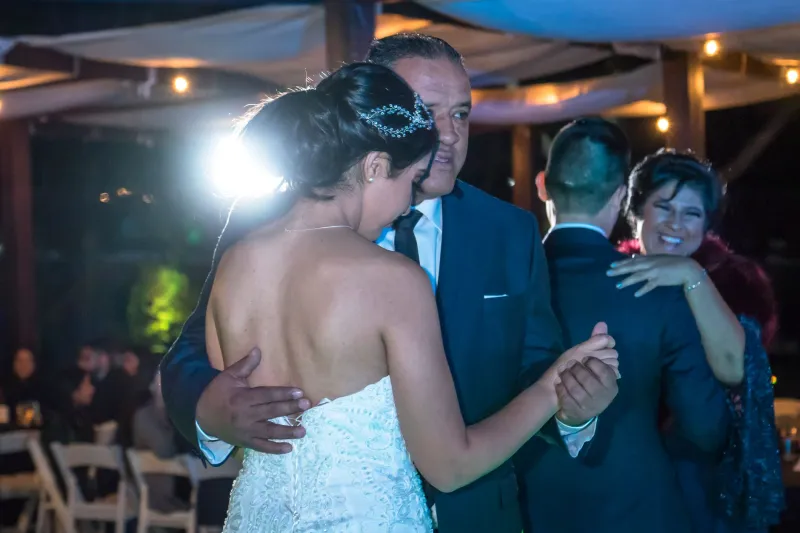
Not the formal one. The one that happens at 10:40pm, when the DJ has finally put something on that they know and nobody's watching. It's usually filmed as background. It shouldn't be.
If your mum and dad are still together, or even if they're not but they're civil, that thirty seconds is a portrait of a marriage that predates yours. Worth mentioning.
3. The box of photographs on the table
Many UK weddings now put out a table of old pictures — grandparents' weddings, school photos, a Polaroid from a first holiday. Guests crowd round it for hours.
Two things to do here. First, ask your filmmaker to capture the table itself, and people looking at it, rather than just a top-down still-life. Second, warn them that the photos may need to be shot again at home in better light — a phone snap of an original print often scans better than footage of a framed picture under a marquee bulb.
4. The goodbye at the door
Grandparents and older relatives tend to leave early, and it's easy to miss them going — you'll be mid-conversation with a friend from work, and by the time you turn round there's a taxi pulling away.
A neat trick: tell your filmmaker roughly when the older guests are likely to head off, and ask them to be near the exit for that window. The hug at the door, the coat being buttoned up, the wave from the car — that's a shot you'll be very glad exists.
5. The getting-ready hands
When couples think 'getting ready', they picture themselves. The better footage is often other people's hands — a mum doing up a row of buttons, a bridesmaid fighting with a veil, a brother wrestling with a cufflink while swearing quietly.
It's also the natural slot for a short, quiet exchange with a parent, if you want one. Say it to your filmmaker in advance if that's something you'd value, because it needs a little breathing room, not a schedule tight to the minute.
6. The line in the speech that isn't about you
Speeches get filmed. But the best moment in a speech is often the sentence that's actually about the speaker — the five words where their voice goes, or the joke that lands and the whole room groans together.
Practical bit: make sure at least one camera or mic is on the speaker's face, not just the couple reacting. And if a speech is being read from paper, ask them to hold it lower than usual so it doesn't block their mouth.
7. The last twenty minutes
By 11pm the room has half emptied. Shoes are off, the DJ is playing something he wouldn't play at 8pm, and someone's uncle is folding chairs. It's the least photogenic part of the day and frequently the most joyful.
If your coverage runs that late, ask for the clear-up. Ask for the last song. Ask for the shot of the empty room afterwards. It's the closing scene, and most films don't have one.
How to ask without handing over a shot list
There's a real difference between 'here are the things that matter to us' and a sixty-item list that turns a filmmaker into a camera operator who's always checking a clipboard.
Keep it to a single message, before the wedding, with three priorities — ranked. Something like: 'If nothing else gets filmed, please get my grandad talking and the last twenty minutes.' Then trust them. A filmmaker who knows your three things will find six more you didn't think of.
And if the day runs away from you — it will — nothing's ruined. Good wedding films are built in the edit from what happened, not from what was commissioned.
A word on privacy and the relatives who'd rather not
Some people genuinely don't want to be filmed, and in the UK most filmmakers are well used to it. Flag it once: 'Please keep Aunt Marie out of shot where you can, she's shy.' That's enough.
Also worth deciding early: is this film just for you two and your families, or are clips going on social media? They're different things, and people relax differently once they know which one it is. If there are children at the wedding, sort the parents' views before the day rather than after.
Timing, briefly
Family moments cluster. Late morning and the first hour after the ceremony are high-energy and good for older guests. Early evening is when the goodbyes happen. The last hour is when the day turns into something else entirely. If you can only ask your filmmaker for one thing, ask them to stay a bit longer than the schedule says, and to keep the camera running when nothing is happening.
Nothing is usually where the good stuff is.