Borrowed Light: How a Grandmother's Super 8 Ends Up in Your Wedding Film
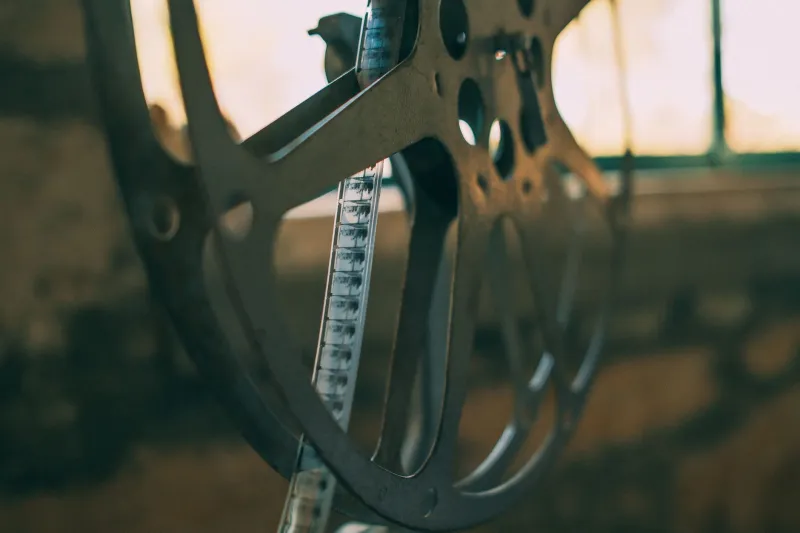
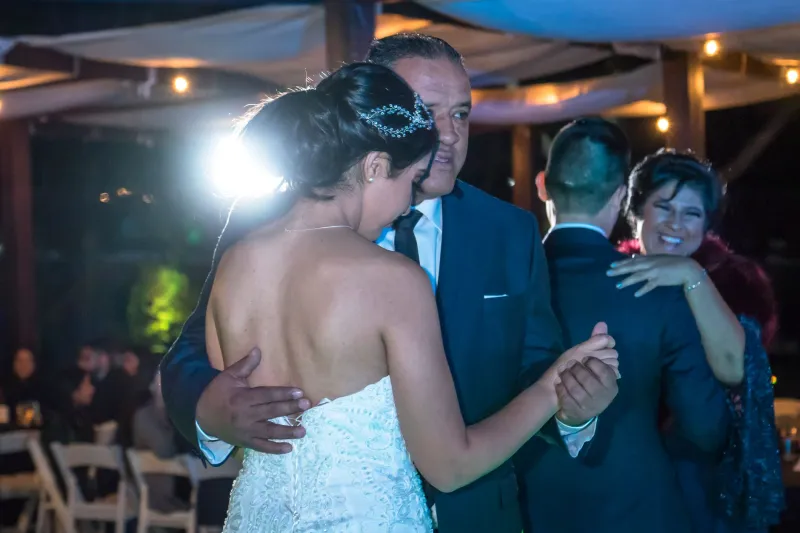
When Ellie and Marcus got married in a converted barn outside Ludlow last spring, they gave their filmmaker something unusual alongside the usual shot list: a biscuit tin. Inside were four Super 8 reels from 1976, filmed by Marcus's grandfather at a family wedding in the same county, and one VHS tape labelled in biro that turned out to be a christening in 1988.
The finished film opens on eight seconds of that 1976 footage — a woman in a wide-brimmed hat squinting into the sun outside a church door — before the gate flicker gives way to the same church door in 2026, filmed on a modern camera, with Ellie walking through it. Different century, same stone. It is, by some distance, the moment their guests talk about most.
The shoebox is more common than you'd think
Ellie and Marcus are not unusual. Plenty of UK couples come to a filmmaker with a box of inherited film and no clear plan for it. That box is usually a mixture: Standard 8 or Super 8 cine reels from the 1960s and 70s, VHS or VHS-C from the 80s and early 90s, maybe a Hi8 or MiniDV cassette from a 2000s family holiday, and at least one tape that has been living somewhere warm for two decades.
The reason it ends up in the wedding film is not nostalgia for its own sake. It is that a wedding film is a story about two families merging, and archive footage is the only material in existence that shows those families before they merged. The grandparents at your wedding were once the guests at a wedding. That is a genuinely extraordinary thing to be able to show on a screen.
Getting it off the shelf without wrecking it
A few practical notes for anyone who has found a tin in the loft.
Handle it carefully and don't run it for fun. Old cine film becomes brittle and warped, and every pass through a projector is a risk. Do not thread it into your uncle's projector to check what's on it. Get it scanned properly first.
Ask for frame-by-frame scanning. A proper telecine scan captures each frame individually rather than filming a projection, which means no flicker artefacts baked in and no damage from the mechanism. Expect it to be priced per reel, usually by duration.
Use a specialist, and consider the regional film archives. The UK has an excellent network: the North West Film Archive, Yorkshire Film Archive, North East Film Archive, Screen Archive South East, Wessex Film and Sound Archive, Media Archive for Central England, and the Moving Image Archive at the National Library of Scotland. Most offer advice even if the reel is your own family's, and a handful of them digitise for the public. High-street and postal transfer services are fine for a clean VHS; for cine, ask specifically what machine they use.
Watch for the two classic loft problems. Acetate film gives off a vinegar smell as it degrades — that is literally called vinegar syndrome and it accelerates in heat and humidity. Mould appears as white bloom and spreads between windings. Both are worth mentioning to whoever scans it, because handling changes.
Check the sound, if there is any. Some later Super 8 reels have a magnetic sound stripe, which is often in worse condition than the picture.
Making 1974 sit next to 2026
This is where a filmmaker earns their fee, and where it usually goes wrong. You cannot simply drop grainy, warm, jittery 4:3 footage into a modern edit and hope. Some deliberate choices help:
- Scan generously, grade gently. A clean scan gives room to work. Then resist the urge to sharpen or denoise the life out of it — the softness is the charm.
- Meet it halfway. A light grain overlay and a touch of halation over the modern footage can pull the two closer without pretending your wedding was shot on a Bolex.
- Frame it deliberately. Archive is 4:3 in a 16:9 world. Some couples go for soft blurred side panels, others a clean black border with a title card, others a full-frame moment where the rest of the film briefly shrinks to match. All work; drifting between them does not.
- Keep the projector sound. The clatter of the gate and the hum of the lamp, kept low under the music, does more than any plugin. It tells the audience they are watching something found.
Three ways filmmakers open with it
The match cut is the crowd-pleaser: grandmother's veil at the church door, cut to granddaughter's veil at the same door. It needs a bit of luck and a lot of looking.
The letterbox reveal is quieter and works beautifully when the archive is thin — a small, hazy frame in the middle of black, then a slow widening into 2026. It reads as a memory surfacing.
The split portrait places old and new side by side, often with a voiceover from a grandparent recorded on a phone a few weeks before the wedding. That recording is worth more than the footage, frankly, and it is the one job you should do yourself: sit down with the older generation, ask them what they remember about the wedding in the film, and press record.
A word on cousins
One thing nobody warns you about. Archive footage belongs to a family, not a couple. Before you build your film's opening around a reel, ask who else appears in it and whether anyone would rather not have those eight seconds broadcast to a hundred guests. Nine times out of ten it is fine. Occasionally a grandparent will say something that saves you a difficult evening.
Ellie and Marcus now have their tin back, along with a scanned copy of every reel on a hard drive. Their film runs to twenty-two minutes. The first forty seconds belong to 1976. Their own grandchildren will one day watch both — and that is the whole point of keeping anything at all.