The Hush, the Vow, the Clink of Glass: Building a Wedding Film You Can Hear
Ask a couple to describe their wedding film and they will usually describe a picture: confetti in the air, a drone sliding out over the marquee, a slow-motion first look. Ask them what they actually cry at, though, and it is rarely a picture. It is a voice. A grandfather clearing his throat before a speech. The vicar's pause before the vows. Your oldest friend's voice climbing at the end of a reading because she is about to lose it entirely.
Sound is the part of a wedding film that nobody plans for and everybody remembers. Which is a bit odd, given it is usually the last thing couples ask about when they are choosing who to hire.
The bit nobody storyboards
Most of the wedding-film conversation in the UK right now is visual. Drone or no drone? Two shooters or three? Anamorphic glass? Fair enough — those things matter. But a film with gorgeous movement and thin, echoey sound plays like a postcard. A film where you can hear the room — the rustle of a dress, a cough from the third row, the clink of a glass as someone calls for quiet — plays like a memory.
The reason is simple. Picture tells you what happened. Sound tells you what it was like to be there. Anyone can point a camera at a wedding. A filmmaker who thinks hard about audio is thinking about what you will feel on your twentieth anniversary, not what will look tidy in a thirty-second teaser.
Four sounds worth protecting
The hush before the aisle. Every wedding has one, usually about ninety seconds before the processional starts. Shoes on stone. A door. Someone whispering that they can see the car. It is the last quiet moment of your life as you currently know it, and it is almost always the first thing dropped in the edit because it is quiet. Ask that it is not.
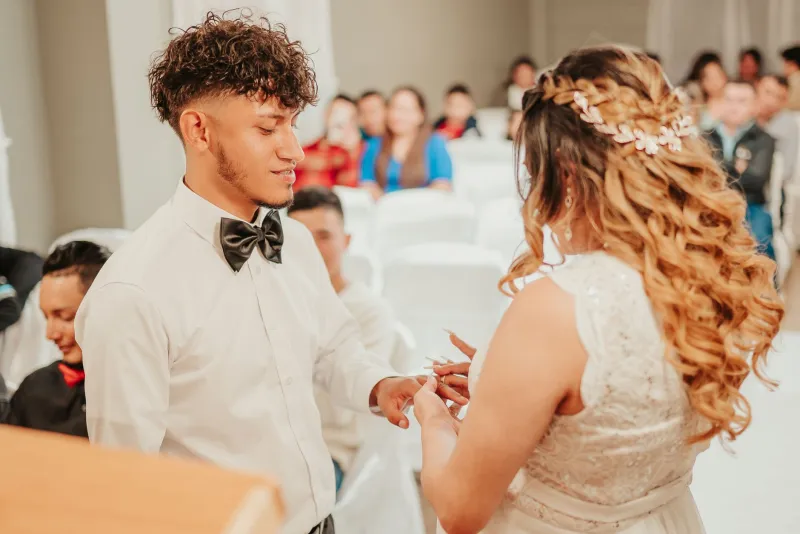
The vows. Not the version you wrote in a notebook — the version you actually said, including the bit where you went off-script and the bit where you had to stop. A lavalier microphone on each of you, discreetly tucked into a lapel or a dress strap, is the difference between hearing your partner's voice crack and hearing a room hum.
The readings. Readers are the forgotten people of wedding audio. They are usually nervous, they often stand at a lectern six feet from any microphone, and their contribution is one of the most personal parts of the ceremony. Worth flagging to your filmmaker in advance, along with a name and a rough position in the order of service.
The speeches — all of them. Particularly the one from the relative who is not a natural performer. A father of the bride who pauses, loses his place, and then says something unrehearsed is worth more than a hundred polished one-liners. That only survives if there is a microphone near him and someone who knows to leave the pause in.
Rooms that fight back
UK venues are, acoustically speaking, gloriously unhelpful. Here is what your filmmaker is actually up against:
- Old churches. Stone absorbs almost nothing, so every word bounces for a second and a half. A microphone on the couple and a separate feed from the vicar's PA, if there is one, will do more than any clever filtering afterwards.
- Marquees. Canvas flaps in the slightest breeze and thuds like a bass drum. A windy day in a field can wreck an otherwise perfect ceremony recording, so a sheltered mic position and a windscreen are not optional extras.
- Coastal venues. Sea breeze plus a lavalier equals a wall of rumble. Windjammers, dead cats and a bit of advance thinking about which side of the building everyone stands on all help.
- Hotels with hard floors. The bar next door, the hand dryer in the loos, a distant cappuccino machine. All audible. All avoidable with a word to the venue.
Questions to ask before you book
You do not need to become an audio engineer. You just need to hear that your filmmaker is one. Try these:
- How many microphones will you run on the day, and where do they go?
- Do you record a backup of the main audio, and on what?
- Will you mic the officiant or take a feed from the venue's sound desk?
- What is your plan for a church with a long reverberation time?
- How do you handle wind at outdoor ceremonies?
- Do you have a setup for readings, or does the reader have to shout?
- Can I hear a full speech from a real wedding, unedited and unmixed?
- What happens if the band's PA is louder than expected during the toast?
- Do you mix and master the audio yourself, or does it go to a third party?
That seventh question is the one that separates the pack. Teasers are edited to hide everything. A three-minute speech, straight from the microphone, tells you exactly what you are buying.
Listen before you fall for the reel
Here is a ten-minute test worth doing before you sign anything. Watch a candidate's film first on a laptop with the sound low, then again on headphones. If the second viewing is the one that gets you — if you suddenly hear a best man's nerves, a child asking a question, the exact moment your stomach dropped — you have found someone who treats sound as part of the storytelling rather than an afterthought.
And if you hear nothing but music? Ask what the raw ceremony audio sounds like. The answer will tell you most of what you need to know.
Small things you can do on the day
You do not need to run the audio yourself, but you can help it along. Tell your filmmaker who is speaking and when. Ask the venue whether the registrar or vicar uses a microphone at all. Warn the band not to start until the last speech has finished. Put the grandparents near a speaker rather than at the very back. And resist the urge to have background music playing during the quiet bits — the quiet bits are the point.
In fifty years, nobody will remember which drone you flew. They will remember the sound of your mum's voice, mid-sentence, deciding whether to carry on. Protect that, and the rest of the film looks after itself.